Paraguay has tons of quirky things:
-At least here in San Salvador, they never plan ahead cooking. They’ll send the boy to the store for flour, then send him again when they realize they don’t have sugar, then again. This is why I could sit outside and see the same boy pass by 10 times a day or more.
-They don’t drink anything during a meal. They wait until the end and then have a glass of beer or water or whatever. It’s horrible.
-They wipe their mouths with the table cloth during meals. It’s normal. Or, alternatively, they share/pass around a cloth rag/napkin.
-Men can piss anywhere. Saw men pissing next to trees in the park in Asuncion. As long as there is a tree or bush, it’s perfectly acceptable.
-People don’t brush their teeth (at least a large majority in Villarica and the area I am in). Because of this, sometimes when people smile, you’ll see a mouth with only a few teeth. Once they all fall out, they just get dentures. It’s almost like a standard process.
-Many people can do nothing, all day long. Maybe they will drink Mate, or Terere (cold mate). And just watch people and sit outside.
-They share 1 cup. If you go to a bar, use 1 cup and pass it around. Doesn't matter how many people. 1 cup is all for everyone.
-When they drink mate, they put ‘Jujos’ in. A jujo is a guarani word. Anyways, a jujo means a weed. It really can be something you pulled up from the side of the road, anything that is green and might have a flavor to it. Also, they sell them in the stores in packages. You can get a wide variety of types…many I’ve never heard of, plus things like parsley, lemongrass, oregano, and many others. I picked up a bunch to send home. A packet of saffron was about 20 cents!
-The lunch is pretty big, then the dinner is small. However, they have an eating schedule comparable to the US. They don’t eat really late.
-Many people speak Spanish and the native language, Guarani. Both are official languages.
-The southern part of Paraguay grows tons of sugarcane. Though, of the farms I’ve seen, they are still in the stone age technology wise.
-The country is incredibly corrupt. The people are apathetic, and don’t care. They are content to do as they always have done. People don’t pay their taxes, but the government doesn’t pursue them. Most of the income for economic development comes from a few large dams. Each city actually gets a large chunk of money for development from the government, but normally most of this money is never seen through to development because someone along the line pocketed it. If the government wasn’t so corrupt, this country seems like it could go somewhere pretty quickly.
-When I barbecued with a few Paraguayans, they thought it was weird I wanted to put some vegetables on the grill. They eat vegetables and fruits, but not this way.
-The fruits here are a nice change from the nothingness of selection in Argentina. There are many more tropical fruits, some which I have never seen before. Lots of them have Guarani names that are impossible to pronounce (Mb seem to be the first 2 letters of lots of words).
-There was a large electric/thunderstorm the other night. The power went out in all of Paraguay. Its confusing, since they have 2 of the largest hydroelectric dams in the world.
-They eat this thing called Manioca. I’ve seen it in the US. It’s a long, brown root. They peel the skin the boil it for an hour. It tastes like absolutely nothing.
-I taught 2 19 year olds how to tie a tie. Then we flossed our teeth with floss after eating. Then, they showed me you can use a piece of a plastic bag as dental floss. I tried it.
Monday, May 24, 2010

Monday, May 17, 2010
Parana
Never got to recap my time in Parana on May 8th/9th...I found a couchsurfing host there for 2 nights, Walter. Walter picked me up at the airport. We dropped my stuff off at his place, which definitely inside seemed like a place you could find in Chicago or New York, it was really nice. The first thing he did was bust out these menus from a restaurant in Amarillo, Texas from where he went on a one month Rotary exchange program. Anyways, it was pretty funny that I recognized the menus from having been there in 2006.
Walter:

Anyways, Parana is like a small big city. It has maybe 400,000 people. It is quite hilly and is set along the Parana river, so it is very green and beautiful. We went down to the waterfront walkway which was mobbed with people strolling along, sitting, and drinking mate. We bumped into plenty of people that Walter knew just walking along.

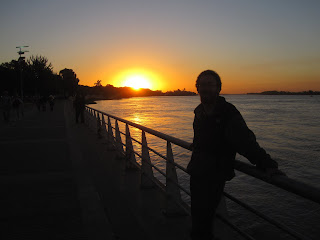
After about 3 hours, I started to lose my voice, which would really suck for the rest of the weekend and lead to my weeklong cold.
It was actually Walter´s birthday weekend. So that night, about 15 of his friends, including 2 of his brothers and their wives, came over. There was plenty of food, including empanadas and some great beef sandwiches, as well as drinks from cerveza to fernet & coke to wine. Everyone was really friendly. I talked sporadically, because my voice was deteriorating by the hour. They probably thought I was weird because of this, but oh well, nobody could hear a dang thing I said. Nonetheless, everyone came over around 1030. I was informed later we would be going to a club. OK, just do what everyone else does. Well, we were on serious Argentinian time, and didn´t leave the apartment for the club until 315AM! Talk about a marathon.
They thought it would be funny if I wore a Parana soccer jersey. Needless to say, many people here and there all night were commenting and I hadn´t a clue. Again, I wasn´t even able to respond cause of my voice. In the end, we left this place at 645 AM, and there were still plenty of people there. New Record.
Sunday, in the afternoon I joined Walter and two of his friends and we went down to the waterfront to drink mate. Couldn´t think of a more typical Sunday afternoon. Around 8pm, his family started to arrive at his place for a birthday gathering. By 9pm, about 20 of his family members (only half his total family) were over, and we were eating pizza and more steak sandwiches. It was great, but also terrible, because I really couldn´t talk to anyone cause of my voice. They probably thought I was either a mute or didn´t know any Spanish. It was fun just being there though.
I caught a 1am bus that night, and my cold progressed to full scale after I had arrived in Mercedes 9 hours later. It probably didn´t help to stay out to 7AM, but the cold spiral had already started a few days before, and it was another unique experience.
Walter and his friends:

They put the jersey from some Parana team on me:

At a club for host Walter's birthday party:

Hanging near the water on Sunday:

Walter:

Anyways, Parana is like a small big city. It has maybe 400,000 people. It is quite hilly and is set along the Parana river, so it is very green and beautiful. We went down to the waterfront walkway which was mobbed with people strolling along, sitting, and drinking mate. We bumped into plenty of people that Walter knew just walking along.


After about 3 hours, I started to lose my voice, which would really suck for the rest of the weekend and lead to my weeklong cold.
It was actually Walter´s birthday weekend. So that night, about 15 of his friends, including 2 of his brothers and their wives, came over. There was plenty of food, including empanadas and some great beef sandwiches, as well as drinks from cerveza to fernet & coke to wine. Everyone was really friendly. I talked sporadically, because my voice was deteriorating by the hour. They probably thought I was weird because of this, but oh well, nobody could hear a dang thing I said. Nonetheless, everyone came over around 1030. I was informed later we would be going to a club. OK, just do what everyone else does. Well, we were on serious Argentinian time, and didn´t leave the apartment for the club until 315AM! Talk about a marathon.
They thought it would be funny if I wore a Parana soccer jersey. Needless to say, many people here and there all night were commenting and I hadn´t a clue. Again, I wasn´t even able to respond cause of my voice. In the end, we left this place at 645 AM, and there were still plenty of people there. New Record.
Sunday, in the afternoon I joined Walter and two of his friends and we went down to the waterfront to drink mate. Couldn´t think of a more typical Sunday afternoon. Around 8pm, his family started to arrive at his place for a birthday gathering. By 9pm, about 20 of his family members (only half his total family) were over, and we were eating pizza and more steak sandwiches. It was great, but also terrible, because I really couldn´t talk to anyone cause of my voice. They probably thought I was either a mute or didn´t know any Spanish. It was fun just being there though.
I caught a 1am bus that night, and my cold progressed to full scale after I had arrived in Mercedes 9 hours later. It probably didn´t help to stay out to 7AM, but the cold spiral had already started a few days before, and it was another unique experience.
Walter and his friends:

They put the jersey from some Parana team on me:

At a club for host Walter's birthday party:

Hanging near the water on Sunday:

Friday, May 14, 2010
The professional Siesta
Having got sick with the flu or something simliar here in Mercedes, Argentina, town of 40,000 people in northern Argentina, and thus staying much longer than I had anticipated, I ended up getting to know some of the people in Rotaract on more than a few occasions.
I finally got a clearer insight onto the siesta last night when it was explained by Ileana. I went out to dinner with Ileana from Rotaract and two of her friends. All three lawyers in their 30s, quite a hilarious experience, me being a 25 year old engineer from the 'big city' in the US.
Anyways, for example, last night they picked me up around 1030 to go to dinner. We didn't start munching on anything until 1130 at least. The place had some really typical live music from this region of Argentina as well. However, it was me who threw in the towel around 1240am, mostly because I was still feeling effects from my cold.
So the next day, they all have to be in to work by 7am. That's not much sleep. They work until 1pm, then shut everything down. Go home for lunch, and probably lunch until 2pm or so. Then, sleep until 4pm. I suppose that puts them at the 8 hour mark in 24 hours for sleep. Then they go back to work for at least 2 or 3 hours.
Kind of weird to think the whole town is sleeping between 2 and 4pm. No wonder I couldn't find a single place open the other day when I was hungry and looking for food!
Eating dinner in Mercedes with Ileana & her friends:

In other notes, Wednesday night got to meet a bunch of people from Rotaract at a meeting. Then Thursday two of them picked me up at my hostel and we walked around the city for a few hours. Nonetheless I saw most of the city in this time. The city is full of gauchos (cowboys). Stopped in a few gaucho wear stores, I really want to purchase one of these hats. For 12-15 bucks, I think thats a go. I look like an idiot, but who cares.
They told me the name of the hat 30 times, and I still can't remember it.

Street (really?):

Main Plaza:

Rotaract meeting:

Old building plus women carrying baby on bike:

Mate from Corrientes (the state that Mercedes is in). Gauchito Gil is like the Argentinian equivalent Robin Hood.

Gaucho sighting:

Baby on Bike:

Gauchito Gil:

Trying on Gaucho hats:

Off to Reserva Esteros del Ibera tomorrow until Monday morning.
Tuesday, May 11, 2010
Santa Fe
I took the bus from Rosario last Thursday the 6th and my host Ignacio told me to tell the driver to get off in ‘Santo Tome’, which I was advised was little more than a stop on the side of the road, no bus terminal…. Well, of course in the end everything went off without a hitch, but it was a little nervewracking on the bus… I made it clear to the ‘stewardess’ on the bus that I needed to be dropped off here and that I had absolutely no clue where I was going so she had to tell me where & when to get off. She advised me, and my host Ignacio was there at the stop.
Santo Tome is like 40,000 people. We then took a bus 20 minutes to Sauce Viejo, which has about 6,000 people. But actually, Ignacio’s house is kind of in a weird middle of nowhere location. 10 km from ‘downtown’ Sauce Viejo, across from the ‘Sauce Viejo Airport’, across also from an Industrial Park, pretty close to split off from the Parana River, and near a large community of expensive houses on dirt roads still retaining a middle of nowhere feeling.
I actually wandered around the area the first day and it was reaaalllly weird. I felt like I was in some surreal movie like Mexican pueblo where all the drug lords live and have huge plots of land and grand houses. On the main road, you see nothing. But then on all the side streets, which are dirt, are large plots of land, with really expensive looking houses and lined with trees. All of them have wooden or steel fences covered by trees or foliage. All of them have multiple dogs in their yards. And all of them have pools and villa like party patios. So I walked around all these streets and it was pretty desolate in general. Every time I walked by someone or a car or motorcycle drove by it was a weird feeling of being an intruder or something. In reality, it really was nothing, as Ignacio explained lots of them are summer houses, but I must say I became a little nervous walking around even though it is incredibly safe. Really hard to explain.


So the first night we went to some pretty amazing, really low key free concert at a museum in Santa Fe. It was a guitarist, a female singer, and a celloist. They played milonga music first in Spanish, then switched to Portuguese and carioca music. The woman could really belt, and in general the music itself was really impressive and talented.
I spent the next day wandering Santa Fe. I went to about 3 museums. All of them detailing in one fashion or another how the Jesuits came in the 1500s to the area, how they founded the city, and influenced the area. One repeated thing I have learned that I did not know, was that Asuncion, in Paraguay, was one of the main arteries of the continent in those days. From there, people were able to access other parts of the countries, so it was really a booming town. If I recall, Asuncion was founded in the 1530s, while the Jesuits then moved south and founded Santa Fe in the 1570s, then Buenos Aires actually was founded shortly after. I went to a Franciscan convent, as well as several churches. Nothing jaw dropping, but most of the stuff was from the 1700s or earlier.
Santa Fe is also known as probably being the beer capital of Argentina. The brewery, cleverly named ‘Santa Fe’, also locally produces Budweiser, Heineken, and a few others. To drink the beer ‘Quilmes’, the other extremely national Argentinian Beer (cleverly named after the city of Quilmes), is like an offense here.
Anyways, Ignacio knows a lot about the history of the area (and has really good English), so I learned a lot. For example, I was unaware of the history with Paraguay. In the 1830s (ish), Paraguay was really booming. Then, basically, Uruguay, Argentina, and Brazil ganged up on them, mercilessly killed many Parguayans, seized a lot of land, and basically devastated the country. It seems as though it has never really recovered, in some ways, from this. I’m sure that’s the translated cliffs notes history. In general, the more time I spend in Argentina, the more history I continue hearing about the Spaniards, Jesuits, violence/eradication of the natives, as well as history with Paraguay.
Continuing with the history theme, I was curious why I was told and noticed that all supermarket owners in Argentina seemed to be Asian. Turns out Argentina has (or had I think) and immigration policy that allowed people from some Asian countries in with the purpose of labouring in rice and wheat plantations. They were given land, but after awhile evolved into an urban population. Especially in Buenos Aires, they are mostly Korean, but also alot of people from Taiwan and China. Also, fun fact: Buenos Aires has a sort of China town area. They build an arch recently, and the Koreans made a bunch of protests because they did not want the label.
The oldest/first Jesuit mission in Santa Fe:

Spend Friday night having a parilla (barbecue), in which we feasted on 2 chorizo’s apiece, grilled 2 eggplants, a red pepper, a huge shank of pork, and a sweet potato. Delicous. Then, proceeded to watch the movie Hitch Hikers Guide to the Galaxy, projected nicely onto the wall in the kitchen.
The parilla:

Also had a nice trip to Walmart late Thursday night. It is interesting to note that all of the supermarkets deliver groceries. You go, pick all your stuff out, then since many people do not have cars, they will have a driver deliver everyones groceries later. Well, Walmart being Walmart, actually just pays for every single person to take a taxi home after they shop there. How come they don't do that in the US?
Frosted Flakes?

Walmart Santat Fe. Looks like any walmart, but this time in Spanish.

Subscribe to:
Posts (Atom)